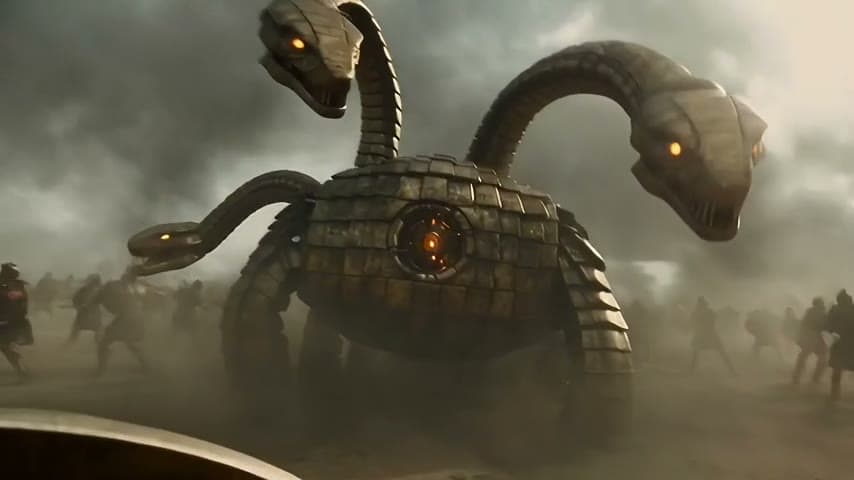
A single unbroken take, no cuts and no black frames throughout, a cinematic first-person POV long take, cinematic lighting effects, extreme photorealism, anamorphic widescreen 2.39:1, 35mm film texture, professional color grading, sharp focus, highly detailed textures, dense organic film grain, shallow depth of field, realistic physical shake like a helmet-mounted camera—continuous handheld micro-tremors throughout, absolutely no gimbal stabilization and no smooth dolly-like movement, real-time speed throughout with absolutely no slow motion.
The entire film is presented through Hercules’ uninterrupted first-person subjective perspective: his own scarred arms remain visible along the bottom edge of the frame at all times—his left hand holds a heavy round bronze shield, and his right hand grips a bronze short sword. @hydra is an ancient bronze automaton multi-headed serpent monster, with its overall form and silhouette following the reference image. Every part of it is made of metal: a lumbering, slow-moving quadrupedal lizard-like torso built from layers of overlapping, sliding bronze and brass armor plates, with oil-blackened steel gears, pistons, hydraulic rods, and tendon-like braided cables exposed through the gaps; the armor plates are covered with verdigris patina and scratches. At the center of its chest, a rotating gear core emits the warm amber glow of a furnace. Four agile, lightning-fast serpent necks are formed from interlocking segments of bronze vertebral rings, with enormous hydraulic jaws full of fangs, dripping scalding black machine oil, and two glowing amber crystalline lenses for eyes. The torso turns heavily and slowly, each step shaking the ground, while the serpent necks strike as fast as whips. All four heads remain in frame throughout the entire film without a single one missing; any heads not fighting the protagonist instead attack other soldiers across the battlefield. More than ten Greek soldiers in bronze armor do not form ranks or clus